

Evaluating carbon markets as a pathway to establishing climate resilient coffee agroforestry systems in Papua New Guinea
Research context
Coffee is Papua New Guinea’s (PNG) second-largest agricultural export and the main cash crop in the Highlands, providing income for nearly half of the country’s rural population. About 85% of PNG’s coffee is produced by smallholder farmers. However, coffee production has faced many challenges in recent decades, including the impacts of climate change. Because climate change affects different areas in different ways, it is important to understand how it may affect Arabica coffee production in the PNG Highlands. Developing effective adaptation strategies also requires an understanding of current coffee farming systems and the social and cultural factors that influence them.
Carbon certification could encourage farming practices that make coffee farms more resilient to climate change. Around the world, demand for carbon-certified coffee has grown as part of broader sustainability efforts. PNG coffee is well suited for this because their traditional farming methods produce very low emissions, and farmers are already familiar with certification processes. However, the adoption of sustainability certifications (e.g. Fairtrade, Organic) in PNG has been relatively slow, with only a limited number of farmers participating.
Project activities and Outcomes
The project aimed to generate knowledge on climate adaptation and carbon opportunities for coffee farmers in PNG highlands and create community resources to help farmers understand climate change and carbon market opportunities and risks. This was achieved through a series of activities outlined below. The findings were presented in Port Moresby in April 2026.
- Desktop research on carbon certification and its application in PNG
To assess the suitability of carbon certification in PNG, ICEDS conducted a desktop review of carbon certification schemes and the co-impacts of other sustainability certifications. This was supplemented by fieldwork with certified coffee farmers to better understand their experiences and perceptions of certification programs.
- Climate change vulnerability analysis and identification of climate adaptation options
Curtin University, Coffee Industry Corporation (CIC), New South Wales Department of Primary Industry and Regional Development (NSW DPIRD), and University of Goroka (UoG) collectively worked on a report that outlined the expected climate impacts on coffee tree physiology and coffee growing areas as well as potential on-farm adaptation strategies for farmers. The report was based on climate projections and field studies across the Highlands.
- Development of community engagement materials
ICEDS, UoG, and CIC developed a series of printed and video materials to share research findings with different audiences. ICEDS led the development of two printed materials: 1) a facilitation guide to help extensions officers explain climate change, its impacts and adaptation strategies to coffee farmers in the Highlands and 2) a booklet summarising the research on carbon certification. Meanwhile, UoG developed four videos to be shared with communities. These videos explained climate change, adaptation strategies, and clarified myths about carbon markets.

Key research findings
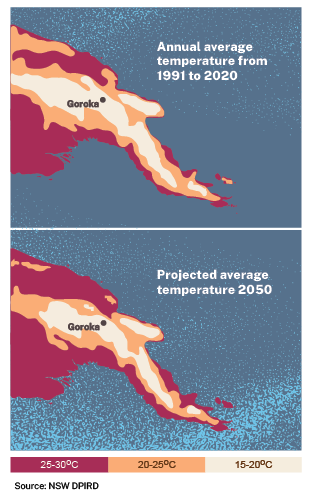
- PNG is expected to experience a 1–2°C increase in mean annual temperatures by the 2050s, with higher elevations seeing the most significant changes. While this warming may improve coffee-growing suitability in some high-altitude areas, it also introduces risks such as increased pest and disease pressure, more frequent droughts, and variable rainfall.
- Field work also identified strategies that farmers were using to manage their coffee in response to local environmental factors, including the targeted interplanting of bananas and taro to manage soil moisture and soil structure. Farmers were also interplanting and managing shade levels in their coffee to maintain food security during seasonal dry periods.
- Key socio-cultural factors that shape adoption of climate adaptations in PNG smallholder coffee systems include diverse livelihoods and priorities; returns to labour; low-input production strategies; household labour dynamics and gendered roles; land ownership and access.
- Strong cooperatives, fair benefit-sharing arrangements along the supply chain, stable demand for certified products, and supportive local governance are all critical for translating certification into real improvements for smallholder farmers. In their absence, certification schemes can struggle to deliver meaningful change and may even impose financial or administrative burdens that outweigh the advantages for producers.
- Despite low carbon farming practices, PNG is a particularly challenging environment for carbon footprint calculation. Coffee production in PNG is mainly carried out by smallholder farmers using diverse agroforestry systems, but low yields, limited records, and poor infrastructure can make it difficult to measure and manage carbon certification requirements.
Key Data
Location: Papua New Guinea
Duration: June 2024 – April 2026
Commissioned organisation: Australian National University
ANU Project Leader: Ms. Ewelina Przybyszewski
Partners: Curtin University, Coffee Industry Corporation, University of Goroka, New South Wales Department of Primary Industries and Regional Development, Australian Centre for International Agricultural Research
Outputs
- Benchmarking carbon calculators for coffee in PNG
- Final report